
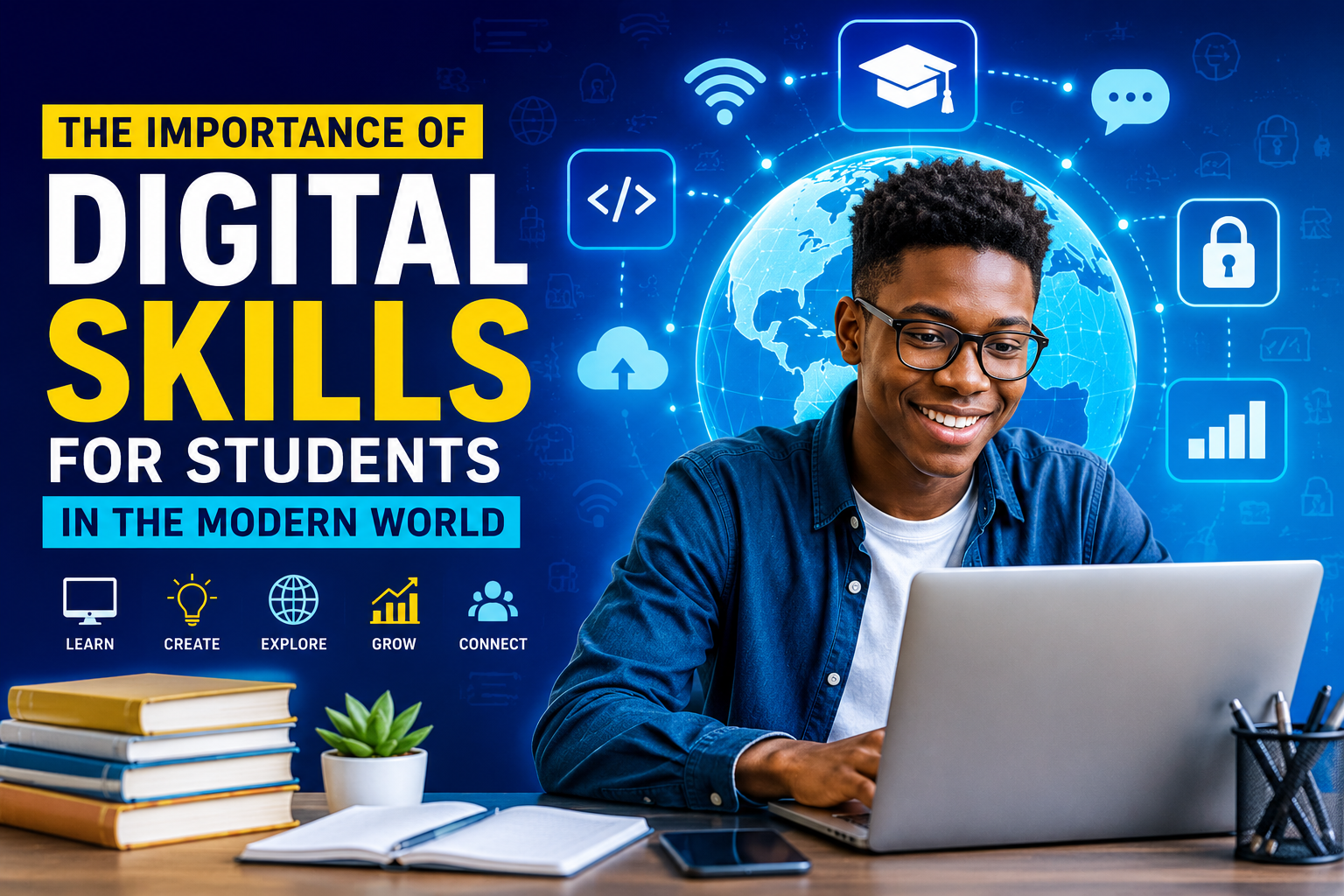
Technology has become an important part of everyday life.
For students, digital skills are no longer just an extra advantage.
They are becoming essential skills for education, communication, and future careers.
The modern world depends heavily on computers, smartphones, the internet, and digital platforms.
Students who understand how to use these tools effectively can enjoy many educational opportunities.
Digital skills refer to the ability to use technology confidently, safely, and responsibly.
These skills include using computers, searching for information, communicating online, creating digital content, and solving problems with technology.
Learning these skills early can prepare students for a rapidly changing world.
Basic Computer Literacy
One of the most important digital skills students can develop is basic computer literacy.
Computer literacy includes knowing how to operate a computer and use common software.
Students should understand how to create documents, organize files, and use presentation tools.
They should also know how to manage folders and protect important digital work.
These simple skills can make schoolwork faster and more organized.
Learning to Research Online
Another important skill is effective internet research.
The internet contains an enormous amount of educational information.
Students can use search engines to find articles, tutorials, books, videos, and other learning resources.
However, finding information is not enough.
Students must also learn how to determine whether the information they find is reliable.
Not everything published online is accurate or trustworthy.
Learning to compare sources can help students avoid misinformation.
Students should check who created a source and when it was published.
They should also consider whether the information is supported by evidence.
Digital literacy therefore involves both using technology and thinking critically about digital information.
Digital Communication
Communication is another important digital skill for modern students.
Students increasingly communicate with teachers and classmates through email, messaging platforms, and virtual classrooms.
Knowing how to communicate clearly online is an important part of digital citizenship.
Students should learn how to write respectful messages and use appropriate language.
They should also understand that online communication can have lasting consequences.
Being polite and responsible online helps create a healthier digital environment.
Creating Digital Content
Another valuable skill is learning how to create digital content.
Students can create presentations, videos, graphics, websites, documents, and other forms of digital media.
Content creation encourages creativity and allows students to express their ideas in different ways.
It can also help students develop skills that may become useful in future careers.
Graphic design is one example of a digital skill that students can explore.
Students can learn how to create posters, educational graphics, presentations, and social media content.
Video editing is another useful skill in today’s digital world.
Students can use video editing tools to create school projects, tutorials, documentaries, and presentations.
These creative abilities can make learning more practical and engaging.
Learning Coding and Programming
Coding and programming are also becoming increasingly valuable skills.
Learning to code teaches students how to break complex problems into smaller steps.
It can improve logical thinking, creativity, and problem-solving abilities.
Students do not need to become professional programmers to benefit from learning basic coding.
Even simple programming projects can teach valuable ways of thinking.
Understanding Artificial Intelligence
Artificial intelligence is also changing the digital skills students need.
Students are increasingly encountering AI tools in education, business, and everyday life.
Learning how AI works at a basic level can help students use it more responsibly.
Students should understand that AI can make mistakes and produce inaccurate information.
They should therefore verify important information instead of accepting every AI response as fact.
Responsible use of AI also means understanding academic honesty.
Students should use technology to support learning rather than simply copying answers.
Becoming Independent Learners
Digital skills can also help students become more independent learners.
Online resources allow students to explore subjects beyond what is covered in their classrooms.
A learner interested in science can find experiments, lectures, simulations, and educational courses online.
Someone interested in business can study entrepreneurship, marketing, accounting, and management through digital resources.
This flexibility allows students to explore their interests at their own pace.
Digital skills are especially important for online learning.
Students taking online courses need to know how to access platforms, submit assignments, join virtual classes, and download learning materials.
They also need to manage their time without the constant physical presence of a teacher.
Good digital habits can make online education more productive.
Students should create organized folders for their digital schoolwork.
They should regularly back up important documents and assignments.
Staying Safe Online
Using strong passwords is another important digital habit.
Students should avoid using the same simple password for every account.
They should also be careful about sharing personal information online.
Cybersecurity awareness can protect students from scams, account theft, and other online threats.
Students should learn to recognize suspicious links, fake websites, and unusual messages.
They should never share sensitive information with unknown people online.
Understanding privacy settings on social media platforms is also important.
Preparing for Future Careers
Digital skills can help students prepare for the workplace.
Many modern jobs require employees to use computers and digital communication tools.
Even jobs that were once mostly physical now often involve some form of technology.
Employers may expect workers to communicate through email, manage digital documents, or use specialized software.
Students who develop these abilities early can enter the workplace with greater confidence.
Digital skills can also create opportunities for entrepreneurship.
A student with the right skills can build a website, design graphics, edit videos, or provide online services.
The internet can connect young entrepreneurs with customers and communities around the world.
This means digital knowledge can become a foundation for future businesses.
Working With Others Online
Technology also makes collaboration easier.
Students can work together on documents, presentations, research projects, and other assignments from different locations.
Online collaboration teaches students how to share ideas, divide responsibilities, and communicate effectively.
These teamwork skills are valuable both in education and employment.
Making Education More Accessible
Digital skills can also make education more accessible.
Students can use tools such as screen readers, captions, speech-to-text, and text-to-speech features.
These technologies can help learners with different needs participate more fully in education.
However, access to technology remains a challenge for many students.
Some learners may not have reliable internet access, computers, or other digital devices.
Schools, communities, governments, and organizations can help reduce this digital divide.
Providing affordable devices, internet access, and digital training can create more equal learning opportunities.
The Role of Parents and Teachers
Parents and teachers also have an important role in developing students’ digital abilities.
They can encourage young people to explore technology while teaching them how to use it responsibly.
Students should be guided toward educational uses of technology rather than spending all their digital time on entertainment.
Learning digital skills does not mean spending every hour in front of a screen.
Students should maintain a healthy balance between technology, physical activity, reading, rest, and face-to-face relationships.
The most important goal is to use technology as a tool for learning and personal development.
Preparing for the Future
Digital skills will continue to become more important as technology develops.
Students who begin learning these skills today can be better prepared for tomorrow’s opportunities.
They can become more confident researchers, creators, communicators, and problem-solvers.
Most importantly, digital skills can help students become lifelong learners.
The modern world is changing quickly, and the ability to learn and adapt is extremely valuable.
Students should therefore see technology not simply as a source of entertainment, but as a powerful educational resource.
With proper guidance and consistent practice, anyone can improve their digital abilities.
Schools and families can work together to give students the knowledge and confidence they need.
Learning these skills is a continuous process because new technologies appear every year.
Students should remain curious and willing to learn new digital tools.
Teachers can also introduce practical digital projects that connect classroom lessons with real-world technology.
Such projects can help students understand why digital skills matter beyond the classroom.
They should practice what they learn through real projects and useful activities.
Every new digital skill can become another step toward greater confidence and independence.
By developing strong digital skills, students can prepare themselves for education, employment, entrepreneurship, and life in an increasingly connected world.
Related Posts
FREE AI TOOLS FOR STUDENTS 2026
Education is no longer about who reads the longest. It’s about who uses AI the [...]
How to Study Effectively and Remember What You Learn
Studying is an important part of education, but simply spending several hours with a textbook [...]
How Technology Is Changing Education
Technology has become an important part of modern education. From smartphones and tablets to computers [...]